
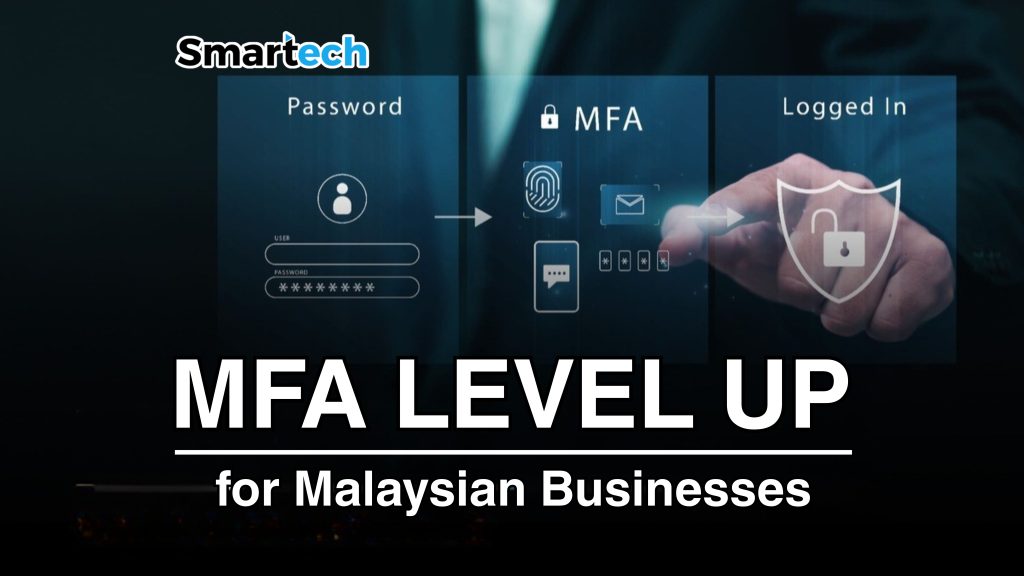
Multi-factor authentication (MFA) has become one of the most commonly recommended security controls for Malaysian businesses—but most organisations implement it in a way that gives a false sense of security. With rising identity risks, remote access, cloud adoption, and regulatory pressures such as PDPA compliance, companies must rethink MFA not as a checkbox, but as a strategic identity security control that effectively reduces breach risk while supporting productivity and governance.
This article explores why traditional MFA implementations fall short, how identity and access management should evolve, and what practical steps Malaysian companies of all sizes can take to level up MFA so it truly protects systems, users, and business outcomes.
What “MFA Done Wrong” Looks Like
Many Malaysian businesses believe they are secure once a basic MFA solution is enabled on user accounts. However, MFA only works as intended when it is configured, enforced, and monitored correctly.
Some common problems include:
MFA is optional for privileged accounts
MFA is only enabled on email but not on all cloud apps
OTPs (one-time passwords) are allowed over insecure channels
Authentication policies don’t consider risk context
No continuous authentication or adaptive policies
These misconfigurations leave gaps that attackers can exploit with social engineering, token interception, or session hijacking.
For Malaysian businesses increasingly reliant on remote teams, hybrid cloud environments, or third-party access, improving identity security is essential to reduce organisational risk.
Why Traditional MFA Isn’t Enough
Traditional MFA delivers an extra layer beyond passwords—typically a mobile SMS code or a one-time token. While better than passwords alone, this approach has limitations:
SMS codes are vulnerable to SIM swap attacks
Static MFA policies do not adjust based on risk context
Employees often resort to unsafe MFA behaviour (e.g., sharing codes)
Privileged accounts may still use weak MFA
Attackers have adapted. Techniques such as push-bombing (repeated exhaustion of MFA prompts) or OTP interception allow skilled adversaries to bypass basic MFA controls.
For businesses in Malaysia that need to protect sensitive client data, financial systems, and cloud environments, this means MFA must evolve beyond “something you have” toward adaptive and risk-aware authentication.
Stronger Identity Controls for Real Protection
The future of MFA is about identity context, not just factors. Strong identity security combines user behaviour signals, device posture, location data, and risk scoring with authentication factors. Relevant controls include:
Adaptive Authentication
Adaptive authentication adjusts requirements based on risk context. For example:
Additional verification if login location changes
More stringent checks for high-risk applications
Flagging suspicious behaviour for human review
This approach makes it harder for attackers to use stolen credentials or automated attacks to bypass MFA.
Risk-Based Policies
Risk-based policies calculate a risk score based on multiple signals such as:
Device fingerprint
User behaviour history
Time of login
Location anomalies
High-risk logins may require stronger verification or temporary lockouts, while low-risk logins remain frictionless for users.
Passwordless and Token-Bound MFA
Moving away from passwords altogether is gaining traction. Methods such as FIDO2/WebAuthn, biometrics, or token-bound device approvals significantly reduce the attack surface compared to passwords + OTP.
For Malaysian companies looking to reduce helpdesk load and improve user experience, passwordless MFA is a strategic next step.
Building an MFA Strategy That Scales
To level up MFA across the organisation, Malaysian businesses should adopt a holistic identity security strategy that encompasses policies, tools, governance, and continuous improvement.
Step 1: Assess Current State
Begin with a complete inventory of systems, applications, and user access points. Identify:
Which systems have MFA enabled
How MFA is configured
Which accounts have elevated privileges
Where exceptions or gaps exist
This assessment reveals the baseline and helps prioritise improvements.
Step 2: Define Access Policies Based on Risk
Not all systems carry equal risk. Design access policies that differentiate between:
Standard applications (low risk)
Sensitive systems (high risk)
Privileged accounts
Third-party access
Establish dynamic authentication policies based on these risk tiers.
Step 3: Extend MFA Across All Entry Points
Ensure MFA covers:
VPN and remote access gateways
Cloud applications
Identity providers (e.g., Azure AD)
Privileged account access
Service accounts where possible
Consistent coverage ensures comprehensive protection.
Step 4: Adopt Adaptive and Contextual Controls
Replace static MFA with risk-aware workflows that consider:
Device health and posture
Geolocation
Behaviour analytics
Time of access
This increases security while reducing unnecessary friction for trusted users.
Step 5: Review and Update Regularly
Identity threats evolve rapidly. Establish a governance cycle to revisit authentication policies quarterly or after significant changes in technology or threat landscape.
6 Practical Tips for Businesses
Use MFA on all entry points, not just email or core applications.
Prefer authenticator apps or hardware tokens over SMS codes.
Create role-based policies that vary based on sensitivity.
Enable adaptive authentication for high-risk scenarios.
Monitor logs for repeated MFA failures or suspicious patterns.
Educate staff on safe practices for MFA prompts and alerts.
Common Business Challenges & Solutions
Challenge [#1]: MFA is enabled but easily bypassed
🎯 SMARTECH Solution: Implement adaptive authentication and risk-based policies that adjust MFA strength based on login context.
Challenge [#2]: Privileged accounts are not sufficiently protected
🎯 SMARTECH Solution: Enforce stronger authentication controls, such as hardware tokens and real-time session monitoring, for all privileged identities.
Challenge [#3]: Users complain about friction with current MFA
🎯 SMARTECH Solution: Adopt passwordless MFA options and risk-aware authentication to reduce unnecessary prompts while maintaining security.
Challenge [#4]: Third-party integrations lack uniform MFA
🎯 SMARTECH Solution: Extend identity security controls and centralised access governance to third-party and contractor accounts to maintain consistent protection.
Challenge [#5]: Lack of visibility into authentication events
🎯 SMARTECH Solution: Deploy an identity analytics platform that aggregates logs and provides dashboards to highlight unusual MFA behaviour patterns.
Key Takeaways
MFA must evolve beyond a checkbox to a strategy
Adaptive, risk-aware authentication is more effective than static MFA
Privileged and third-party access requires stronger controls
Passwordless and token-bound approaches improve security and experience
Regular governance and reviews sustain MFA maturity
Educating users reduces bypass behaviour and increases protection
Identity security aligns directly with business outcomes and resilience
For comprehensive protection around identity and access, see Smartech’s guidance on contractor access management and identity governance.
Learn how identity security supports broader cybersecurity maturity across organisations.
Related Blogs Section
🌐 Top 5 Cybersecurity Mistakes That Leave Your Data at Risk
🌐 Cybersecurity and Compliance for Malaysian SMBs
🌐 10 Biggest Cybersecurity Mistakes of Small Companies
🎯 Need Help?
Strong identity security isn’t optional — it’s a foundation for modern business governance, compliance, and risk management. Smartech helps Malaysian businesses implement robust MFA, adaptive authentication, and identity management frameworks tailored to your operational needs and risk profile.
Discuss your identity security strategy with our experts and ensure your MFA strategy truly protects what matters most.